Showing posts with label editing. Show all posts

Tuesday, March 6, 2012

A little harsh, don't you think?

While inserting 'up' as a sloppy way to help verbs is well established, it's still wrong. Unless you're writing this sign. And in that case, make the error, because cleaning your dog's euphemistically describe poop seems unnecessary.

Monday, March 5, 2012

OK, now what?

Tip: Add copy to explain new business model or be courteous enough to provide link to the tabloid story that led to the posting of this notice.

Thursday, April 9, 2009

Copy Editor's Lament


A lovely mixture of melody and lyric brings the tragedy of the dying copy desk home at Christopher Ave's site, Music for Media.
"Copy Editor's Lament" makes you laugh and cry at the same time, especially if, like the protagonist, you've been laid off! (And, if you're like me, you met your future wife on the copy desk in college).

An excerpt:
"I'm a human safety net...I can provide punctuation, appropriate for publication, make the capitalization right. I was there to fix your grammar when you thought it wouldn't matter, cut all your extraneous blather down."

Copy editors are among the tens of thousands of reporters and editors who have been cut loose in the past year or two in North America. As Ave puts it in the song, "with only Web sites and TV, nothing really there to help you see."

Yeah. Good luck with that.

In any case, here's to Christopher Ave and all of you who understand the difference between a colon and a semicolon.

Friday, February 13, 2009

In writing, measure twice, cut once

PR industry consultant Sam Whitmore has been tracking editorial accuracy (as if he doesn't have enough to do!). It falls loosely under the umbrella that smaller editorial staffs are doing more work and stress cracks are emerging. He used as an example an error in a Wall Street Journal story about an SAP product. His email blast today contained the following:
It turns out that the WSJ no longer has a copy desk per se. Senior editors still read and edit stories, but recent layoffs have decimated the layer of fit-and-finish wordsmiths -- copy editors and slot readers -- that reinforced the WSJ's hard-earned reputation for excellence. Also, WSJ production systems don't make it easy for reporters see a headline before it runs. This creates risk when stories are technical, like the SAP piece.
This anecdote illuminates a ignored problem within digital publishing: When a piece of content is published, regardless of when it's corrected, the original incorrect version not only can get into millions of hands quickly but can also exist in certain forms even after the correction.
The moral to the story? Similar to a carpenter (who should measure twice, cut once): edit many, publish once.


Tuesday, February 3, 2009

The Art of Editing

Our son, a high school sophomore, demonstrated over breakfast today why that adage about jazz is just as true about writing: Often it's what you leave out that resonates more than what you put in.

He was reading a story in the San Francisco Chronicle about a trial of a man accused of shooting the bullet that paralyzed a young boy while he was playing piano.

Here's the lede:
(02-02) 17:58 PST OAKLAND -- The 11-year-old boy paralyzed by a gas station robber's bullet while taking a piano lesson in Oakland still plays music and basketball - but now, he does both from a wheelchair.

My son's suggestion: Replace "paralyzed" with "hit" or "struck" or "shot," and you have a better lede. The changed construction adds an element of suspense to the sentence because it leaves out the outcome of the shooting until the end of the sentence. The emotion-coaster that creates in a single sentence is breathtaking: He was shot! Oh, he survived! He can play basketball and piano! Oh! He's paralyzed and in a wheelchair!

Writing is just as much about engaging with readers as it is about the raw conveyance of ideas and information, even in the digital age. Whether it's in print or online or in an email newsletter, good writing engages the mind.
You do that, and the rest will follow.

Wednesday, August 6, 2008

Where have all the editors gone?


Sports writer Dave Albee writing in this morning's Marin IJ on local rower Mike Altman in the Olympics:

IN ROWING, the focus usually comes from within rather than from outside visuals. That's how it is when your back is always turned away from the finish line.

Funny, I thought in rowing your back was always facing the finish line.

S.F. Chronicle Science writer David Perlman had his own problems today. He wrote about rampant rumors of cover-ups over Mars research:

The latest heady rumor: that the spacecraft Phoenix now analyzing soil and ice on the arctic plains of Mars had discovered chemicals so startling and so relevant to the search for life on the Red Planet that the White House and the president's science advisers have been secretly briefed, even though NASA would not share the information with the public.

The logical structure of the last clause doesn't work. NASA's not sharing information with the public isn't at odds with the White House having a secret briefing. They're part and parcel of the same thing.

To the two Davids: We're concerned about your copy desks, but the good news is we're still reading.
(As for the photo, it's a beauty, and it's from a fine photographer, Kevin Sargent)

Wednesday, May 7, 2008

Say what you mean


Writing functions both as a spotlight and as a shield. It you want it to function as the former, it's important to strip out all ambiguity from your sentences, otherwise it's simply a waste of everyone's time.
Take Treasury Secretary Hank Paulson's less-than-encouraging quotation this week about the financial markets:
"I do believe that the worst is likely to be behind us."

That came from a Wall Street Journal story, headlined: "Paulson Sees Financial Turmoil Abating." His quotation, however, says nothing of the sort. It's "likely." His quote says, to me, "maybe we're coming out of it; maybe not."
If he really means to say the financial turmoil is easing, he'd have said: "The worst is behind us."
It's unsettling--when so many of us are unsettled that we haven't hit bottom--that the secretary of the treasury is unsure.

Friday, April 25, 2008

The sentence is imperiled: Pew Study

The Pew Research Center is out with a study this week about writing and teens. There's good news and bad news. The good news is teens write more today than older generations. The bad news from "Writing Technology and Teens:" emoticons and abbreviations threaten the sentence. The study quotes James Billington, the Librarian of Congress:
Young Americans' electronic communication might be damaging "the basic unit of human thought -- the sentence."
Some highlights from the report:
  • 93% of teens say they write for their own pleasure. FOR THEIR OWN PLEASURE. WOW!
  • The impact of technology on writing is hardly a frivolous issue because most believe that good writing is important to teens' future success.
  • Teens more often write by hand for both out-of-school writing and school work.
  • Teens believe that the writing instruction they receive in school could be improved. (OR, MIGHT WE SUGGEST, SUPPLEMENTED BY A CERTAIN WRITING BLOG...)
An Associated Press dispatch about "Writing Technology and Teens" focused on the impact that technology (IM and text-messaging for example) are having on formal writing.
"It's a teachable moment," said Amanda Lenhart, senior research specialist at Pew. "If you find that in a child's or student's writing, that's an opportunity to address the differences between formal and informal writing. They learn to make the distinction ... just as they learn not to use slang terms in formal writing."
"Writing Technology and Teens" doesn't delve into what defines formal writing. Some would say it needs to cover all communications, from email to memos to proposals to contributed articles. Some might argue that different styles fit different forms. I fall into the latter camp.
I think the bigger problem is that the time pressures on everyone in the work place (at least the American work place) are hurting good writing just as much as technology may. It takes time to formulate a coherent thought and then communicate it. If we keep that in mind, we'll be fine. If we continue down our increasingly manic work-environment path, we'll be in trouble.

Monday, April 21, 2008

Batter up


The first month of the 2008 Major League Baseball season is nearly in the bag, and that calls for some reflection. I was driving somewhere this weekend, listening to the Giants' game, when my wife made an insightful remark (not unusual). Why, she asked, do they say he "flied out" when a ballplayer hits a fly ball that is caught by a fielder? Shouldn't it be flew out? Good question. Freedictionary.com doesn't even mention it, instead defining "to fly out" as

To rush out. To burst into a passion.

Occasionally, you'll hear a broadcaster use "flew out," but not often. It's all the more surprising as it's common to hear a broadcaster describe a long home run by saying "that ball just flew out of here!" (We're not hearing this too frequently this season with the Giants, but that's another story).
The other faux pas that all broadcasters make is the use of the acronym for runs batted in (RBI). "A-Rod has three RBIs today," a broadcaster might say. In fact, the plural needs to be RBI (runs batted in). And then you'll hear newbies exclaim "It's gone! A grand slam home run!" Usually, their more experienced microphone partners will take them aside and gently remind them that a grand slam by definition is a home run.
Such are the things I ponder when my team is forecast to lose 100 games this season.

Thursday, March 27, 2008

Verbing

I had a rare chance to listen to the broadcast version of Michael Krasny's "Forum" program no KQED radio today as I drove down to Silicon Valley for an interview. On it, he hosted author and journalist Marilee Strong of Oakland, who has written a book "Erased: Missing Women, Murdered Wives."
Really interesting interview that you can hear here. Really annoying use of the verb "disappeared."
As in: "When he disappeared his wife." I have never heard this construction in my life, and it sounds wretched. But the dictionary allows disappear to be a transitive verb, meaning it can take an object.

v. tr.
To cause (someone) to disappear, especially by kidnapping or murder.

(From Dictionary.com)


I don't know. It still makes me feel creepy saying it.

Tuesday, March 25, 2008

On writing

I could be wrong about this, but I doubt it. (I once gave my dad a Father's Day card that had that sentiment). Email and IM and the immediacy they introduce into our lives are enabling people to write lousy sentences.
It's not just that email and IM are fast, throw-away forms of communication. They encourage fragmented thoughts (splash something out, hit send, move on to the next message or task).
In this world, prepositions grow like kudzu. They lengthen sentences, bore the reader and obscure meaning.
Write actively, not passively. Show your writing who's boss.

I came across this construction this week:
One of the key learning’s I want to start off by highlighting is never pretend to be something you’re not online.
That's what we get paid the big bucks for.

Sentences should be constructed in such a way that the reader is almost forced to stick with it from beginning to end--the way you roll down a grassy hill. For the reader, it should be effortless.

Wednesday, March 12, 2008

Headline of the day

San Francisco Chronicle, Food Section:

Tripe lovers
reveal their
offal secrets


Didn't even need a squeeze to fit the one column.
If you're an offal fan, read on.

Friday, March 7, 2008

It's personal...or not

Screw up your pronouns, and you can look naked as a writer:

“Today’s savvy marketers are quickly realizing that viewing the customer as merely a target is a critical mistake. In fact, referring to the people that consume their products as anything other than people, is a mistake.”

And writing about people with a pronoun other than “who” is a mistake as well.

Onward... into new-word hell:

Onboarding: "...in the case of onboarding (adding a new hire)."

In some organizations, I hear this process can be as painful as waterboarding.

Trialing: "Advertisers have been willing to trial these products." It's trial to come across these constructions, but it's what I get paid the big bucks for!

Wednesday, March 5, 2008

Coffehouse words


Many writers tend to jump on trendy words as quickly as they do trendy food and cocktails. Usually they do so without understanding the meaning. Abused about as badly as Michael Vick 's dogs is word "ironic." It's been hip for years, and it continues to be hip. Like cockroaches, I suspect, it will survive nuclear war. It's a word you pick up in college coffee houses, listening to your English major friends chat about Proust. It sounds intellectual. Most college graduates stagger out into the world having forgotten most of what they learned in school save for precious words such as ironic. They use such words liberally to erase any suspicion among strangers that they forged their diplomas.

Today, an otherwise insightful column from Mediapost, began this way:

I'M WRITING THIS COLUMN FROM the office of a Facebook Friend, ironically enough, as there was a building collapse in Harlem this afternoon that has canceled all train service out of Grand Central for the foreseeable future. Who knows when I might see the home office again?

A tough situation to be sure, but not ironic. Irony conveys meaning that is the opposite of its literal meaning. It might be ironic (or just plain bizarre) if the writer were typing from the office of the building that collapsed, but that's not the case.

So think about those coffee-house words before you employ them.


Onward... another day's worth of redundancies

Integral part: Integral means "part of" something.
End result: A result is the end of a process.
Irrefutable facts: A fact is something that exists, that is reality. Unless you're channeling Descartes, facts aren't refutable. (While we're at it, you might want to use "refutable" where applicable rather than "irrefutable." The latter is in the dictionary, but means the same thing--and the former's 1505-1515 origin beats the latter by a century).
Contributing factor: Factor: 1. one of the elements contributing to a particular result or situation.

Monday, February 25, 2008

An abundance of fodder


Andy Kessler, who wrote "How We Got Here," is one of my favorite business columnists. I catch him in The Wall Street Journal whenever he makes it onto the op-ed page. Today, he has a column titled "Internet Wrecking Ball," about the so-called "net-neutrality" issue.
I call out a couple of minor boo-boos (not to pick on Kessler but because I've got to post an item, and a bird in the hand is twittering at me):

"I personally would climb telephone poles on my street..." If you're doing the climbing, Andy, you can't outsource it. It's going to be personal.

"Yes, despite an overabundance..." (Part of the definition of the word abundance is "oversufficient quantity or supply," so overabundance is overly oversufficient and going over-over the top. But aha! you say, as if you've lured me into a rusty bear trap that has snapped violently around my ankle: Why, then, is the word overabundance in the dictionary? Because smart people who write dictionaries sometimes screw up.
Can you use overabundance? Sure. You can use colloquialisms too. But my point is: edit paranoid. The more critically you look at every word, the more you will whittle your copy into cogent prose and communicate clearer thought.

Wednesday, February 20, 2008

The Period As Statement


Women's Wear Daily reports today that The Wall Street Journal 's planned magazine, Pursuits, which is scheduled to launch in September, has been renamed WSJ. (That's W S J period). WWD quoted a Journal spokesman as saying:

"The three letters happen to be typographically quite pleasing. And its simplicity gives us enormous flexibility visually and semantically."
I haven't been able to track down the font yet, but it's worth noting that down to the period used WSJ., it's different from than The Wall Street Journal masthead type font. That style is Escrow, designed by Cyrus Highsmith, a graduate of the Rhode Island School of Design. Tomaso Capuano, who designed the quarterly Times of London supplement, Times Luxx, is designing WSJ.
In an era in which video rules our lives, words are devalued and typography seems quainter than quill pens, this is a fabulous story. The Journal, in fact, always has placed a premium on typography since the paper until relatively recently was text heavy, black and white and ran few graphics. And to my knowledge, The Journal is the only newspaper in North America that puts a period at the end of its name.

Tuesday, February 19, 2008

Many, Multiple and Myriad


In writing, people tend to hunt for $10 words when the nickel version works. "Many" is just one of those words. Like an old sweater, reach for it when you need it. Often, in an attempt to sound more serious or professorial, people will use "multiple." It's fine, but I'm not crazy about it. It reminds me of math class.
Then there are times when writers drop back in the pocket, look down field and go for the long bomb: "Myriad."
It's a good word, although it can sound a little pompous, but, hey, sometimes it's good to thrown down like that. It's almost always misused in a sentence: "...the result of a myriad of factors."
That's essentially saying "it's the result of a lot of a lot factors."
Proper grammar, for instance as an adjective, would be "There are myriad reasons the Giants will lose 100 games this season, but we can start with the starting nine."

It's a noun and an adjective meaning a very great or indefinitely great number of things. It's from the Latin myria, meaning 10,000.

Onward...

A couple of recent updates to the AP Stylebook online:

Asian-American

A person of Asian birth or descent who lives in the U.S. When possible, refer to a person's country of origin. For example: Filipino-American or Indian-American. Follow the person's preference. See nationalities and race, and race entries.

heart attack, heart failure, cardiac arrest

A heart attack (myocardial infarction) occurs when one or more arteries supplying blood to the heart becomes blocked. Heart failure is a chronic condition that occurs when a weakened heart can no longer effectively pump blood. Cardiac arrest, or sudden cardiac arrest, occurs when the heart suddenly stops beating. It can be due to a heart attack, a heart rhythm problem, or as a result of electrocution or other trauma.

Wednesday, February 6, 2008

It's in the genes


My daughter had to remind tonight that I forgot a key memory in the opening post of this blog. We're all a product of environment and genes, and I left out a great anecdote.
My paternal grandfather was a businessman, Stanford Class of 1910. Was a friend of Hoover, so much so that when Hoover ran the European relief effort after World War I, he put my grandfather in charge of Poland. It's a biography waiting to be written. That's a shot of him, far left, at a Mills College function in 1935. I think he was on the board of directors. You'll notice he's holding his right arm. He contracted polio in Poland and it withered his left arm, and I think he was self-conscious about it.
Anyway, Maggie reminded me that the old man read books with a pencil in one hand. We have evidence up at our place in the mountains: dozens of old books. He didn't underline much, but he did edit with that pencil, circling mispellings and correcting grammars, putting commas where they should have been.
Get a life? Perhaps. I think the dictionary on the stand, which I mentioned on Greeley's Ghost, was his idea.
The point is I'm doomed. Maggie, our daughter, is probably doomed; Malcolm too (he already calls out "added bonus" anytime he hears it on the TV or radio. It's great for your mind; not so great for your friends.
C'est la vie.

Onward...

Driving the wordsmith to school today, we heard...
"Fully engulfed," which ranks right up there with "totally destroyed" and the arson that was "intentionally set."

Tuesday, February 5, 2008

A (good) quote a day keeps the boredom away


One of the biggest challenges in journalism and PR is the quote. It's also the biggest lost opportunity.
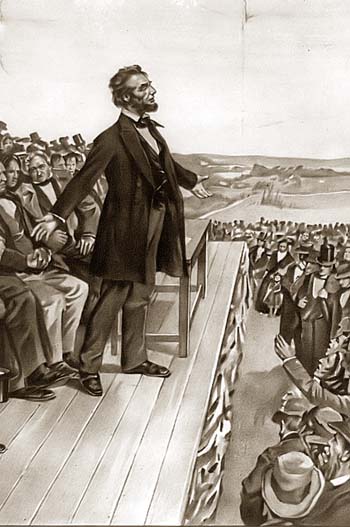
In the wire-service business I was taught to quote someone only if I couldn't paraphrase the sentiment better. I was reminded that I was a writer, and that's what I got paid to do (I worked with a number of reporters over the years who used quotes liberally, and 99 percent of them aren't in the business anymore). A reporter or historian might have written "87 years ago," but Lincoln said "Four-score and seven," and they're four of the more memorable words in the English language.
In PR, quotes start out like crater-sized holes in a press release outline: "INSERT COMPANY/VENDOR/CUSTOMER QUOTE HERE." They go downhill from there. For many professionals, it's an afterthought. Almost without exception, press release quotes are dull and devoid of meaning.
Here's a winner from today's BusinessWire feed:

By implementing a standard way of managing the collaboration between technologies, EDRM has capitalized on the industrys readiness to work together and move the entire industry forward.


Replace "EDRM" with anything and it works in any industry. It's also meaningless. It's like saying people love warm sunny days.
Quotes, although tricky to write well, don't have to be this bad.
If you're in PR, use the quote to get your message across in a way that can't be paraphrased (journalists use canned quotes all the time, but they won't use crappy ones). You will get pushback from your client, but persevere because it will pay off. If you're a journalist, keep asking questions until you get a quote you can use.
A lot of this is writing 101, but it gets lost in the flood of information we all produce every day.

Onward...

Rob Cox, on BreakingViews.com, has a fine post today that imagines a note from Yahoo CEO Jerry Yang to Microsoft's Steve Ballmer, responding to MSFT's $44.6 billion offer to buy his company.

However fine the post, it contained a couple of teaching moments.
"...came as a complete surprise." While not a hard-core redundancy, this example illustrates how a little discipline can go a long way in writing. Surprise speaks for itself; unless there's a time element (latest surprise), why modify its degree? A surprise is a surprise is a surprise. The more we modify words that stand resolutely on their own, the more muddled our communication becomes.

"...articulating our admittedly complicated strategy." All "Jerry" has to write is the word "complicated," and he's admitting its complexity. This too can be a gray area, but it's better to put all adjectives and adverbs under the magnifying glass in the heat of the day. More often than not, you should end up searing them into oblivion.

Monday, February 4, 2008

The facts on de facto

I came across this line while editing today:
"To date, the current de facto standard is...."
This is a belt-and-suspenders approach to writing. "To date" and "current," especially when you're writing in the writing tense (and if you're not, you've got other problems) are redundant here. "Current" is "to date." I'd much prefer "The standard is..."
Now for "de facto" ... this gets interesting. The definition is "in fact, in reality." Using it as a modifier here is like adding a second set of suspenders with your belt. A standard is a fact in this case. Webster's Unabridged provides a fine illustration of how to use de facto:
"Although the school was said to be open to all qualified students, it still practiced de facto segregation."

Onward to online...

From BBC online: "A total of 24 states will hold nominating contests on Super Tuesday." Better: "Twenty-four states xxx" (Geez, from the Brits, the fathers of the mother tongue).

Jennifer Lehr's opening line on the Huffington Post: "I've been totally obsessed with the primaries."
If you've got an obsession, I can guarantee you it's total. Obsession. 1. The domination of one's thoughts or feelings by a persistent idea, image, desire, etc. From the Latin obsessio meaning blockade or siege.

Contributors


Copyright 2006| Blogger Templates by GeckoandFly modified and converted to Blogger Beta by Blogcrowds.
No part of the content or the blog may be reproduced without prior written permission.