Sunday, March 11, 2012
Monday, March 5, 2012
Sunday, February 14, 2010
Funny Sunday Headlines
- From the Marin IJ: Teasing a story about a local female skier, editors on page 1 presented: “Armenian Team Taps Skier From Novato.”
This is one of those verb choices that, while tailor-made for tight-real estate newsprint, really should be stricken from the copy desk’s tool belt.
- From the New York Times, a photo caption accompanying the story "A Balance Between the Factory and the Local Farm" reads:
Pavle Milic decided to serve only
I don't know about you, but a teste test sounds really unpalatable, until you discover that the singular of testes is testis.
Even so, don't look for Rocky Mountain Oysters for Mr. Milic's customers, it appears--test or no test.
Thursday, February 11, 2010
Dear Twitter, Please Take Bonehead English
"You may follow (person's name) as well by clicking on the 'follow' button on their profile."
Jesus H. Christ! Hey, Biz Stone, (btw, I'm blogging on one of your earlier creations, thank you) 99 percent of the people who follow other people are people (or more precisely a person). That takes the SINGULAR PRONOUN. Please change your email notifications so that it reads
"You may follow (person's name) as well by clicking on the 'follow' button on his or her profile."
Or
"You may follow (person's name) as well by clicking on the 'follow' button on the user's profile."
We're cutting back on education funding in these dark economic times, Biz. Don't contribute to the dumbing down of America with one of the most popular social media features of the day.
Wednesday, January 27, 2010
Paging New York Times' Copy Chief
Obituary: Billy Preston, 59, reknowned keyboardistYes, it seems we all knowed Billy Preston.
P.S. Preston died in 2006, and if memory serves, The Times hadn't gutten its staff just yet.
Monday, January 25, 2010
Are stripper-linguists getting a raw deal??
The question is, are strippers Alexia Moore (left) and Falynn Rodriguez better lap dancers or linguists?
That's what put-off prosecutors are wondering in New York this week after the two gyrating gals fought a prostitution charge.
In trying to have the charges dropped on a technicality, the pair argue that language is paramount (and we could argue no more vociferously).
According to the New York Post (and check out the lede):
The purportedly glitchy grammar in the charges against the pair alleges that they "did engage, offer and agree" to acts of prostitution with an undercover officer at Big Daddy Lou's Hot Lap Dance Club on West 38th Street in July 2008. That differs from the wording in the state penal code, which specifies "engage, offer or agree," the gals argue.
This just goes to show that some people can dance and parse language at the same time.
God Bless America.
(Tip of the fountain pen to Duffy Moran for bird-dogging this gem).
Monday, January 11, 2010
A handy guide to dealing with apostrophes

Almost a year ago, I posted a couple of times about the Apostrophe Catastrophe over in Merry Olde England.
Just came across an amusing and graphical rule on apostrophe's from theoatmeal.com.
Cute and it comes as a poster. Schools should buy these by the truckload. No child should be allowed to move on from grammar school unless he passes a test that includes getting the right forms of "it's" and "its" correct.
Wednesday, January 6, 2010
Oxford University Press' Word of the Year was...
"It has both currency and potential longevity,” notes Christine Lindberg, Senior Lexicographer for Oxford’s US dictionary program. “In the online social networking context, its meaning is understood, so its adoption as a modern verb form makes this an interesting choice for Word of the Year. Most “un-” prefixed words are adjectives (unacceptable, unpleasant), and there are certainly some familiar “un-” verbs (uncap, unpack), but “unfriend” is different from the norm. It assumes a verb sense of “friend” that is really not used (at least not since maybe the 17th century!). Unfriend has real lex-appeal.”
(I don't know about you but I get a kick out of "lex-appeal.")
In any case, the pace of language change seems to have ramped up in recent years thanks to inventions emanating from the technology world (Google as a verb, for instance, meaning to search). Being the pseudo-snob I am when it comes to language I once that that trend was dreadful, but I've changed my tune. With technology changing the world so fast, language must keep up.
In fact, it seems people are just as passionate about language as ever, judging by the comments on the Oxford blog referencing one of the finalists in the judging: Tea-bagger. Scores of commenters weighed on on the term, which has both political and sexual definitions (although Oxford avoided publishing the latter definition).
(P.S. None of our words of the day entries made the list, but then again, all of those are already in the dictionary).
Monday, January 4, 2010
Death of the written word? Hardly

We worry in these precincts about the death of the written word. But people actually read more today than in years (perhaps ever). True, "writing" has been redefined as more digital belching in many cases. But the immense amount of new information created every second of every day is written. Just spend a few minutes with a good real-time search site like Collecta and you see how much is bubbling up--some of it banal, but much of it worth a read and your valuable time.
Researchers Roger Bohn and James Short point out that reading as a percentage of our information consumption has actually tripled in the past 50 years if we use words (on printed page or digital screen) as a measurement. The chart shows the transformation of reading in the past 50 years.
So, those of you with a passion for writing, fear not. There's plenty of upside in our world. And given the vast amount of information that's produced every second in printed form, there will always be a demand for those who can write clearly, concisely and cleverly.
Friday, May 1, 2009
Where Have All The Editors Gone?

There once was a time when if you wrote a headline like this for a wire service, a grizzled vet across the newsroom who edited your copy would explode in laughter or rage. If you were a greenhorn, it would be the latter rather than the former. Either way, the vet's coffee would be spilled all over the desk, ashtray knocked to the floor--such would be the umbrage taken at the headline and story description of this suspect.
The editor would stand and hitch up his pants over his pot belly and question the writer's manhood, intelligence and college pedigree in language that would peel paint. (At least mine did).
Now pictures may be deceiving, and John Floyd Thomas Jr. could be eight feet tall, but he doesn't look like he weighs 800 pounds. Either of those physical features would qualify Thomas as the "largest ever" serial killer.
Instead, he's suspected of being the most prolific killer in L.A.'s history, a fact that Thomas Watkins notes in his lede. So why does the headline quote robbery-homicide Capt. Denis Cremins bludgeoning of the language?
"If he turns out to be the guy, he probably would be the largest ever (serial killer) in the city of Los Angeles."We may never know, just as we may never know why serial killers are "prolific," "indefatigable," hardworking," "dedicated," "diligent" or "tireless."
Friday, April 17, 2009
Word of the Day: Chthonian (gesundheit!)
Occasionally, I come across a word I couldn't even imagine existed, have never heard and couldn't make up if my life depended on it. Today was such a day.
Chthonian (tho' ne un): Pertraining to the deities, spirits and other beings dwelling under the earth.
A variation was used in Meghan Cox Gurdon's brilliant essay in today's Wall Street Journal on eco-propaganda in children's literature (Carl Hiaasen being her poster boy in this case).
If you have somehow missed the fact that April 22 is Earth Day, it's probably because you are grown up. Were you a child, there's not a chance you'd be allowed to miss the urgent chthonic nature of the day -- nor the need to recycle, to use water sparingly, to protect endangered creatures and generally to be agitated about a planet in peril.This weekend in the mountains, as I lay down on the ground to sleep under the stars, I will no doubt listen for faint chtonic sounds emanating from below me, maybe from the goddess pictured here.
And it'll probably keep me awake all night!
Tuesday, February 24, 2009
New Gig, Old Books
That work, which I did first thing yesterday morning, may be akin to a soldier checking, oiling and testing his weapon. I felt a granite sureness in pulling out Webster's Unabridged, The Chicago Manual of Style, Follett, Fowler, Strunk and White and the AP Stylebook. Weapons and ammo. Check. Ready to go to battle.
I mentioned this in a Tweet and got an interesting response from an old colleague, an award-winning wordsmith in his publishing days.
Strunk and White? Are you kidding? The days of having 30 minute arguments of serial commas and whether one means anticipation or simple expectation are days of yore, old friend.I understand where he's coming from, in an era of 140-word Tweets and IM slang that's, OMG, 2die4.But sunshine peeks through the clouds. His response coincided with a request from a colleague at Blanc & Otus. A client wanted to resolve an internal discussion about how to handle compound modifiers. He was wondering whether their copy was too hyphen-happy.
There, in the pages of those great language books, was the guidance we so often have trouble finding these days: Use the hyphen to avoid confusion. "Small-business owners" means something different than "small business owners."
So people still care. Are these people graying around the temples, raised at a time when we read books not screens, tapped typewriters not keyboards? Perhaps. But at the agency I got urgent questions from twenty-somethings (note the hyphen) about serial commas, about punctuation, about style. It matters.
People, like nature, abhor a vacuum.While the language evolves as it should, business communications, done well, will always adhere to rules.
Friday, February 13, 2009
In writing, measure twice, cut once
It turns out that the WSJ no longer has a copy desk per se. Senior editors still read and edit stories, but recent layoffs have decimated the layer of fit-and-finish wordsmiths -- copy editors and slot readers -- that reinforced the WSJ's hard-earned reputation for excellence. Also, WSJ production systems don't make it easy for reporters see a headline before it runs. This creates risk when stories are technical, like the SAP piece.This anecdote illuminates a ignored problem within digital publishing: When a piece of content is published, regardless of when it's corrected, the original incorrect version not only can get into millions of hands quickly but can also exist in certain forms even after the correction.
The moral to the story? Similar to a carpenter (who should measure twice, cut once): edit many, publish once.
Thursday, February 12, 2009
The Apostrophe Catastrophe Continues
An updated dispatch from the Daily Telegraph indicates the good guys are still losing the good fight.
Wakefield Council in West Yorkshire said that it did not include the punctuation mark on road signs "to avoid confusion", even where the name was intended to take the possessive.One of the good guys turns out to be the uncle of an EE Times colleague of mine, David Blaza.
Here, here, Mr. Blaza. Now that said, check out the photos here. The upper photo is from the earlier coverage and shows no apostrophe. The lower photo is from the more recent story. It has an apostrophe but appears to be a different sign placed in a slightly different position near the church.Allan Blaza of the Pontefract Civic Society accused the council of ducking its responsibility to maintain standards.
He said: "I think it's a cop out. I'm sufficiently rigorous when it comes to the English language, which is a magnificent language, to feel sure that all the grammatical necessities – not niceties – should be observed."
So there's hope.
Monday, February 2, 2009
Catastrophe for Apostrophes
Birmingham, England, officials have decided it's okay not to have apostrophes.
Councilor Martin Mullaney, who heads the city's transport scrutiny committee, said he decided to act after yet another interminable debate into whether "Kings Heath," a Birmingham suburb, should be rewritten with an apostrophe.
"I had to make a final decision on this," he said Friday. "We keep debating apostrophes in meetings and we have other things to do."
Martin, why on Earth are you debating apostrophes? There's nothing to debate. They're a crucial part of understanding a written piece of communication.
Perhaps you should pass a law allowing people to spell Birmingham any which way they choose. Or renaming it. I'd vote for Mullaney's Folly.
Tuesday, January 20, 2009
The Writer in Chief
Imagine that: A writer in the White House. It's a been a while. Maybe not since Kennedy (although Profiles in Courage was a bit of an outsourced endeavor).
Noonan wrote in this weekend's Wall Street Journal:
Mr. Obama is a writer, and he sees himself as a writer. It is an important part of his self-perception. He is the author of two books, the first of considerable literary merit. He loves words. It is in writing that he absorbs, organizes data, thinks his way through to views and decisions, all of which adds to the expectations for his speech.I can relate to that.
On Greeley's Ghost last year, I wrote of Obama's muse, Abraham Lincoln and how gracefully he describes his favorite portrait of Lincoln.
Could it be that a writer--The Writer in Chief--could navigate our troubled waters? We've had a businessman, two career politicians and an actor in the Oval Office since 1980. We've had good times and bad. And, I'd suggest, we've been frustrated at one level or another.
We need someone who can articulate not only our troubles but the way forward. In an age of sound bytes, text messages and IM, the complexities of the world around us are lost, vaporized in unknowing, uncaring, inarticulate ones and zeroes.
With his savvy use of new media, it could very well be that Obama, the writer, is the right man at the right time, able to analyze, synthesize and articulate complex problems and bridge old forms of communications with new, while using language to inspire and lead.
There's hope yet.
Friday, August 15, 2008
Oh, the horror!
Joseph Califano Jr. leaps atop the language of Wall of Shame this morning in an article about kids raiding their parents' medicine cabinets to steal prescription drugs. Said he, in a statement:
Many problem parents become passive pushers by leaving abusable and addictive prescription drugs, like their painkillers OxyContin and Vicodin, around the house, making them easily available to their children.Since Califano's organization, the National Center on Addiction and Substance Abuse, is located at Columbia University, I won't be passive about pushing this link to its English department faculty in case he has a hankerin' to double-check his language before his next public pronouncement.
Wednesday, August 6, 2008
Where have all the editors gone?
Sports writer Dave Albee writing in this morning's Marin IJ on local rower Mike Altman in the Olympics:
IN ROWING, the focus usually comes from within rather than from outside visuals. That's how it is when your back is always turned away from the finish line.
Funny, I thought in rowing your back was always facing the finish line.
S.F. Chronicle Science writer David Perlman had his own problems today. He wrote about rampant rumors of cover-ups over Mars research:
The latest heady rumor: that the spacecraft Phoenix now analyzing soil and ice on the arctic plains of Mars had discovered chemicals so startling and so relevant to the search for life on the Red Planet that the White House and the president's science advisers have been secretly briefed, even though NASA would not share the information with the public.
The logical structure of the last clause doesn't work. NASA's not sharing information with the public isn't at odds with the White House having a secret briefing. They're part and parcel of the same thing.
To the two Davids: We're concerned about your copy desks, but the good news is we're still reading.
(As for the photo, it's a beauty, and it's from a fine photographer, Kevin Sargent)
Monday, July 28, 2008
(A) wanker
In British slang, a wanker is a pejorative term for someone who plays with himself or is a detestable person.
One example would be Giles Coren, a restaurant reviewer in England, who went ballistic on newspaper copy editors ("subs" as they're called) for removing the article "a" from one of his reviews.
He picks it up from here, in all his foul-mouthed, verbose petulance. At the end of the day, he has a point that the deletion of that single letter ruined a good double entendre. But, really Giles, is it worth vaulting yourself into the modern Pantheon of jackasses to make a point? I guess it is.
(Tip of the fountain pen to my old colleague Paul Dempsey for the article reference).
Monday, June 30, 2008
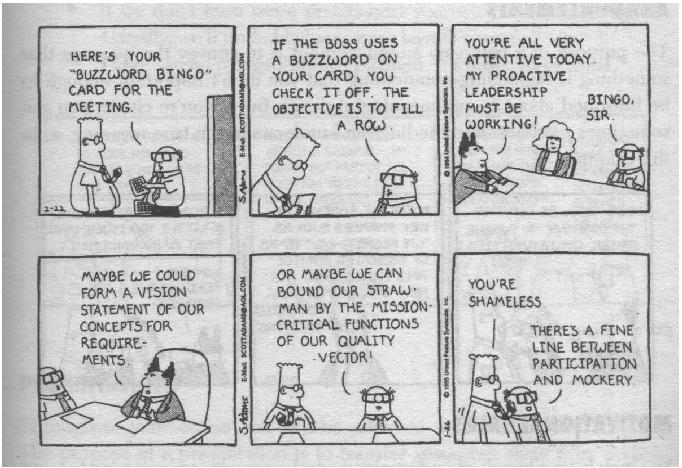
Gobbledygook
Gobbledygook means language characterized by circumlocution or jargon. The word seems to originated, according to Webster's, between 1940-45, which makes sense because World War II was in full swing, and the military is famous for gobbledygook.
David Meerman Scott writes this morning that authorities in England and Wales are trying to end its life span here and now. Across the pond, the Local Government Association is urging governmental officials to junk jargon.
Said LGA Chairman Sir Simon Milton:
"The public sector can not, must not and should not hide behind impenetrable jargon and phrases. Why do we have to have 'coterminous, stakeholder engagement' when we could just 'talk to people' instead?"
(Would you expect anything else from a Milton? Paradise may yet be regained!)
The list includes: coterminous, empowerment, stakeholder, slippage, synergies and best practice. If these were outlawed in the United States, business communications might come to a crashing halt.
Onward....
My ex-EE Times colleague Alex Wolfe suggests actor William Shatner is changing careers...radically.
His new autobiography is titled "Up Till Now," which suggests Shatner is telegraphing a move into farming. It's discouraging to see a book--presumably reviewed by editors--titled in thus, when it should be "Up 'Til Now."
Contributors
Blog Archive
-
▼
2013
(2)
- ► 11/10 - 11/17 (1)
-
►
2012
(4)
- ► 03/11 - 03/18 (1)
- ► 03/04 - 03/11 (2)
- ► 02/26 - 03/04 (1)
-
►
2010
(9)
- ► 02/14 - 02/21 (2)
- ► 02/07 - 02/14 (1)
- ► 01/24 - 01/31 (3)
- ► 01/10 - 01/17 (1)
- ► 01/03 - 01/10 (2)
-
►
2009
(13)
- ► 12/27 - 01/03 (1)
- ► 04/26 - 05/03 (1)
- ► 04/19 - 04/26 (1)
- ► 04/12 - 04/19 (1)
- ► 04/05 - 04/12 (1)
- ► 02/22 - 03/01 (1)
- ► 02/08 - 02/15 (2)
- ► 02/01 - 02/08 (2)
- ► 01/25 - 02/01 (1)
- ► 01/18 - 01/25 (2)
-
►
2008
(59)
- ► 08/10 - 08/17 (1)
- ► 08/03 - 08/10 (1)
- ► 07/27 - 08/03 (1)
- ► 06/29 - 07/06 (2)
- ► 06/22 - 06/29 (1)
- ► 06/15 - 06/22 (4)
- ► 06/01 - 06/08 (2)
- ► 05/25 - 06/01 (1)
- ► 05/11 - 05/18 (1)
- ► 05/04 - 05/11 (2)
- ► 04/27 - 05/04 (1)
- ► 04/20 - 04/27 (3)
- ► 03/30 - 04/06 (1)
- ► 03/23 - 03/30 (2)
- ► 03/16 - 03/23 (2)
- ► 03/09 - 03/16 (2)
- ► 03/02 - 03/09 (3)
- ► 02/24 - 03/02 (4)
- ► 02/17 - 02/24 (4)
- ► 02/10 - 02/17 (3)
- ► 02/03 - 02/10 (4)
- ► 01/27 - 02/03 (7)
- ► 01/20 - 01/27 (7)