Showing posts with label syntax. Show all posts

Friday, May 1, 2009

Where Have All The Editors Gone?


There once was a time when if you wrote a headline like this for a wire service, a grizzled vet across the newsroom who edited your copy would explode in laughter or rage. If you were a greenhorn, it would be the latter rather than the former. Either way, the vet's coffee would be spilled all over the desk, ashtray knocked to the floor--such would be the umbrage taken at the headline and story description of this suspect.
The editor would stand and hitch up his pants over his pot belly and question the writer's manhood, intelligence and college pedigree in language that would peel paint. (At least mine did).
Now pictures may be deceiving, and John Floyd Thomas Jr. could be eight feet tall, but he doesn't look like he weighs 800 pounds. Either of those physical features would qualify Thomas as the "largest ever" serial killer.
Instead, he's suspected of being the most prolific killer in L.A.'s history, a fact that Thomas Watkins notes in his lede. So why does the headline quote robbery-homicide Capt. Denis Cremins bludgeoning of the language?
"If he turns out to be the guy, he probably would be the largest ever (serial killer) in the city of Los Angeles."
We may never know, just as we may never know why serial killers are "prolific," "indefatigable," hardworking," "dedicated," "diligent" or "tireless."

Friday, April 17, 2009

Word of the Day: Chthonian (gesundheit!)


Occasionally, I come across a word I couldn't even imagine existed, have never heard and couldn't make up if my life depended on it. Today was such a day.

Chthonian (tho' ne un): Pertraining to the deities, spirits and other beings dwelling under the earth.

A variation was used in Meghan Cox Gurdon's brilliant essay in today's Wall Street Journal on eco-propaganda in children's literature (Carl Hiaasen being her poster boy in this case).

If you have somehow missed the fact that April 22 is Earth Day, it's probably because you are grown up. Were you a child, there's not a chance you'd be allowed to miss the urgent chthonic nature of the day -- nor the need to recycle, to use water sparingly, to protect endangered creatures and generally to be agitated about a planet in peril.
This weekend in the mountains, as I lay down on the ground to sleep under the stars, I will no doubt listen for faint chtonic sounds emanating from below me, maybe from the goddess pictured here.
And it'll probably keep me awake all night!

Friday, August 15, 2008

Oh, the horror!


Joseph Califano Jr. leaps atop the language of Wall of Shame this morning in an article about kids raiding their parents' medicine cabinets to steal prescription drugs. Said he, in a statement:
Many problem parents become passive pushers by leaving abusable and addictive prescription drugs, like their painkillers OxyContin and Vicodin, around the house, making them easily available to their children.
Since Califano's organization, the National Center on Addiction and Substance Abuse, is located at Columbia University, I won't be passive about pushing this link to its English department faculty in case he has a hankerin' to double-check his language before his next public pronouncement.

Monday, June 30, 2008

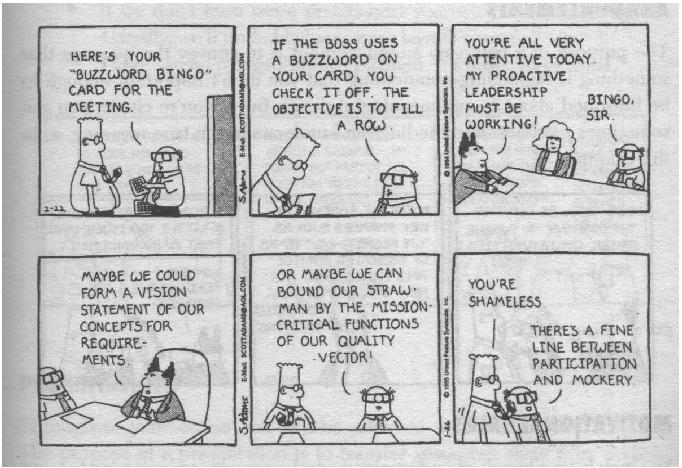
Gobbledygook


Gobbledygook means language characterized by circumlocution or jargon. The word seems to originated, according to Webster's, between 1940-45, which makes sense because World War II was in full swing, and the military is famous for gobbledygook.
David Meerman Scott writes this morning that authorities in England and Wales are trying to end its life span here and now. Across the pond, the Local Government Association is urging governmental officials to junk jargon.
Said LGA Chairman Sir Simon Milton:
"The public sector can not, must not and should not hide behind impenetrable jargon and phrases. Why do we have to have 'coterminous, stakeholder engagement' when we could just 'talk to people' instead?"

(Would you expect anything else from a Milton? Paradise may yet be regained!)
The list includes: coterminous, empowerment, stakeholder, slippage, synergies and best practice. If these were outlawed in the United States, business communications might come to a crashing halt.
Onward....
My ex-EE Times colleague Alex Wolfe suggests actor William Shatner is changing careers...radically.
His new autobiography is titled "Up Till Now," which suggests Shatner is telegraphing a move into farming. It's discouraging to see a book--presumably reviewed by editors--titled in thus, when it should be "Up 'Til Now."

Monday, June 16, 2008

Oh so trendy

I returned today from a vacation of relaxin', readin' (Mark Helprin's "A Soldier of the Great War," for the second time) and writin' (notes for a novel that's beginning to congeal in my soupy head) to discover the editing business still needs editors.
I Googled the phrase "passing fad" to find 345,000 citations. That means that 345,000 times some writer didn't care enough to think before putting fingers to keyboard. While not strictly redundant, the word "fad" means a "temporary fashion," so a fad is, by definition, passing. Would that we should think as much before writing as we do before stepping off a city curb. By the way, I was moved to this demi-diatribe by a Moira Herbst's BusinessWeek article: Energy Efficiency: A Passing Fad?
On a different note, I've enlisted the help of a longtime editorial colleague of mine, Jackie Damian, to contribute to this blog from time to time. (I'd love for it to be daily, but she does have a real life!) Jackie is one of the finest editors I've ever worked with. I've seen her transform the unintelligible into the articulate and the workable into the insightful. Her first contribution comes later this week.

Monday, June 2, 2008

Word of the Day: Guerdon


n. A reward, recompense or requital. (As a verb, to reward).

The word has several Middle English derivations, all of which probably come from the Latin donum, or gift, according to Webster's Unabridged.
You're probably wondering why guerdon shouldn't have a more martial meaning, with similar words like guerilla. That's because those ME derivations include a variation of widar, to give back.
Guerdon is what Sameer Mishra (left) spelled to win the 2008 Scripps National Spelling Bee in Washington last Friday. For winning, his guerdon includes $35,000 and a $2,500 savings bond. Not bad for getting your letters right.

Wednesday, May 28, 2008

Bad grammar "Eccos" relentlessly

Ecco makes pretty good shoes. Their ad agencies writes pretty painful ad copy.
From the recent "My World My Style" print and online campaign:
"I will spend the entire day just walking on my feet. So for my shoes, comfort and styles have to go hand and hand. My Ecco is Yucatan."
Do advertising agencies no longer employ copy editors? Does the "feel" of the copy outweigh the value of the words that produces it?
"I will spend the entire day just walking on my feet"...???? As opposed to.... your hands?? That would be quite a feat!
And less obvious but still grating: "comfort and styles have to go hand and hand." I get it, but when the product is shoes, isn't there a better simile??

Friday, May 16, 2008

Word of the Day


Tergiversate: (v) to change repeatedly one's attitudes or opinions.
From the Latin tergiversatus, to turn one's back.

I haven't come across that word ever, and it's a beauty. Found it Joe Queenan's Wall Street Journal op-ed today on, who else? Hillary Clinton. Fits like a glove.

Monday, April 28, 2008

Stating the obvious

Often in covering tragic and dramatic news stories, reporters get carried away and lose their writing discipline. Such was the case with last week's shark attack off Solana Beach, Calif., that killed triathlete David Martin.
Witnesses said he was lifted vertically out of the water by the creature, which retreated after a single bite.
My son, reading the story, caught the error: "lifted vertically." To lift means to raise, and the last time I checked, raising is a vertical movement.

Friday, April 25, 2008

The sentence is imperiled: Pew Study

The Pew Research Center is out with a study this week about writing and teens. There's good news and bad news. The good news is teens write more today than older generations. The bad news from "Writing Technology and Teens:" emoticons and abbreviations threaten the sentence. The study quotes James Billington, the Librarian of Congress:
Young Americans' electronic communication might be damaging "the basic unit of human thought -- the sentence."
Some highlights from the report:
  • 93% of teens say they write for their own pleasure. FOR THEIR OWN PLEASURE. WOW!
  • The impact of technology on writing is hardly a frivolous issue because most believe that good writing is important to teens' future success.
  • Teens more often write by hand for both out-of-school writing and school work.
  • Teens believe that the writing instruction they receive in school could be improved. (OR, MIGHT WE SUGGEST, SUPPLEMENTED BY A CERTAIN WRITING BLOG...)
An Associated Press dispatch about "Writing Technology and Teens" focused on the impact that technology (IM and text-messaging for example) are having on formal writing.
"It's a teachable moment," said Amanda Lenhart, senior research specialist at Pew. "If you find that in a child's or student's writing, that's an opportunity to address the differences between formal and informal writing. They learn to make the distinction ... just as they learn not to use slang terms in formal writing."
"Writing Technology and Teens" doesn't delve into what defines formal writing. Some would say it needs to cover all communications, from email to memos to proposals to contributed articles. Some might argue that different styles fit different forms. I fall into the latter camp.
I think the bigger problem is that the time pressures on everyone in the work place (at least the American work place) are hurting good writing just as much as technology may. It takes time to formulate a coherent thought and then communicate it. If we keep that in mind, we'll be fine. If we continue down our increasingly manic work-environment path, we'll be in trouble.

Monday, April 21, 2008

Batter up


The first month of the 2008 Major League Baseball season is nearly in the bag, and that calls for some reflection. I was driving somewhere this weekend, listening to the Giants' game, when my wife made an insightful remark (not unusual). Why, she asked, do they say he "flied out" when a ballplayer hits a fly ball that is caught by a fielder? Shouldn't it be flew out? Good question. Freedictionary.com doesn't even mention it, instead defining "to fly out" as

To rush out. To burst into a passion.

Occasionally, you'll hear a broadcaster use "flew out," but not often. It's all the more surprising as it's common to hear a broadcaster describe a long home run by saying "that ball just flew out of here!" (We're not hearing this too frequently this season with the Giants, but that's another story).
The other faux pas that all broadcasters make is the use of the acronym for runs batted in (RBI). "A-Rod has three RBIs today," a broadcaster might say. In fact, the plural needs to be RBI (runs batted in). And then you'll hear newbies exclaim "It's gone! A grand slam home run!" Usually, their more experienced microphone partners will take them aside and gently remind them that a grand slam by definition is a home run.
Such are the things I ponder when my team is forecast to lose 100 games this season.

Friday, April 4, 2008

Good news, bad news

The bad news is that California kids need to improve their writing skills. The good news is that those of us who make a living with words don't have to worry about job security any time soon.
Just a quarter of the state's eight-graders scored at grade level in writing. New Jersey has the nation's best young writers.

California students have improved, however. The writing test was last administered in 2002, when 23 percent of the state's students scored at grade level. In 1998, 20 percent did as well.


Thursday, March 27, 2008

Verbing

I had a rare chance to listen to the broadcast version of Michael Krasny's "Forum" program no KQED radio today as I drove down to Silicon Valley for an interview. On it, he hosted author and journalist Marilee Strong of Oakland, who has written a book "Erased: Missing Women, Murdered Wives."
Really interesting interview that you can hear here. Really annoying use of the verb "disappeared."
As in: "When he disappeared his wife." I have never heard this construction in my life, and it sounds wretched. But the dictionary allows disappear to be a transitive verb, meaning it can take an object.

v. tr.
To cause (someone) to disappear, especially by kidnapping or murder.

(From Dictionary.com)


I don't know. It still makes me feel creepy saying it.

Tuesday, March 25, 2008

On writing

I could be wrong about this, but I doubt it. (I once gave my dad a Father's Day card that had that sentiment). Email and IM and the immediacy they introduce into our lives are enabling people to write lousy sentences.
It's not just that email and IM are fast, throw-away forms of communication. They encourage fragmented thoughts (splash something out, hit send, move on to the next message or task).
In this world, prepositions grow like kudzu. They lengthen sentences, bore the reader and obscure meaning.
Write actively, not passively. Show your writing who's boss.

I came across this construction this week:
One of the key learning’s I want to start off by highlighting is never pretend to be something you’re not online.
That's what we get paid the big bucks for.

Sentences should be constructed in such a way that the reader is almost forced to stick with it from beginning to end--the way you roll down a grassy hill. For the reader, it should be effortless.

Wednesday, March 19, 2008

Word of the Day


It's study hall at home tonight--quiet and peaceful. My wife is reading "Tortilla Curtain," written by T.C. Boyle.
She comes across one of those words you love but are usually too lazy to look up:

Peregrination.
It means a walk or traverse, although it sounds like it should mean something a lot more complex, like the act of staring at a subway map in a foreign land trying to figure out where to go. It's obviously related to peregrine, which means "having a tendency to wander" and is a type of falcon (Falco peregrinus).
The Latin root, peregrinus, means pilgrim.
And with that, it's time to fly.

Friday, March 7, 2008

It's personal...or not

Screw up your pronouns, and you can look naked as a writer:

“Today’s savvy marketers are quickly realizing that viewing the customer as merely a target is a critical mistake. In fact, referring to the people that consume their products as anything other than people, is a mistake.”

And writing about people with a pronoun other than “who” is a mistake as well.

Onward... into new-word hell:

Onboarding: "...in the case of onboarding (adding a new hire)."

In some organizations, I hear this process can be as painful as waterboarding.

Trialing: "Advertisers have been willing to trial these products." It's trial to come across these constructions, but it's what I get paid the big bucks for!

Wednesday, March 5, 2008

Coffehouse words


Many writers tend to jump on trendy words as quickly as they do trendy food and cocktails. Usually they do so without understanding the meaning. Abused about as badly as Michael Vick 's dogs is word "ironic." It's been hip for years, and it continues to be hip. Like cockroaches, I suspect, it will survive nuclear war. It's a word you pick up in college coffee houses, listening to your English major friends chat about Proust. It sounds intellectual. Most college graduates stagger out into the world having forgotten most of what they learned in school save for precious words such as ironic. They use such words liberally to erase any suspicion among strangers that they forged their diplomas.

Today, an otherwise insightful column from Mediapost, began this way:

I'M WRITING THIS COLUMN FROM the office of a Facebook Friend, ironically enough, as there was a building collapse in Harlem this afternoon that has canceled all train service out of Grand Central for the foreseeable future. Who knows when I might see the home office again?

A tough situation to be sure, but not ironic. Irony conveys meaning that is the opposite of its literal meaning. It might be ironic (or just plain bizarre) if the writer were typing from the office of the building that collapsed, but that's not the case.

So think about those coffee-house words before you employ them.


Onward... another day's worth of redundancies

Integral part: Integral means "part of" something.
End result: A result is the end of a process.
Irrefutable facts: A fact is something that exists, that is reality. Unless you're channeling Descartes, facts aren't refutable. (While we're at it, you might want to use "refutable" where applicable rather than "irrefutable." The latter is in the dictionary, but means the same thing--and the former's 1505-1515 origin beats the latter by a century).
Contributing factor: Factor: 1. one of the elements contributing to a particular result or situation.

Monday, March 3, 2008

National idiom shortage

You think the economy's in bad shape? Check out a Page 1 Onion story in the current edition.
Since beginning two weeks ago, the deficit in these vernacular phrases has affected nearly every English speaker on the continent, making it virtually impossible to communicate symbolic ideas through a series of words that do not individually share the same meaning as the group of words as a whole. In what many are calling a cast-iron piano tune unlike any on record, idiomatic expression has been devastated nationwide.

Wednesday, February 27, 2008

On writing

Roy Peter Clark at Poynter has an interview this week with legendary sports writer Frank Deford, famous for his work, among other places, at short-lived The National (I have a copy of the last issue) and at Sports Illustrated.

The interview got me thinking about writing techniques. Deford has a couple of good ones:

· He types his written notes to get a sense for what he has, doesn’t have and needs to get.

· He uses colored paper to block out chunks of his stories (the historical background on blue, for instance).

· And if he has writer’s block (I’ll dedicate a post to this at a later date), he just starts somewhere and works from there (say in the middle and writes to the end and then figures out the top).

Writing in business is straightforward: You’re trying to communicate simple messages effectively; not elaborate on chaos theory. There’s always a beginning, a middle and an end. The beginning is what you’re going to say; the middle is what you want to say; and the end is recapping what you just said.

Visualizing that structure is relatively simple.

Deford’s techniques (and others) are effective on much more complex writing projects. The most valuable book I ever read on writing is “The Art and Craft of Feature Writing” by William Blundell, a onetime editor for The Wall Street Journal. Blundell taught me to use 3x5 index cards to frame both major and minor points, including quotes. You can then lay the cards out in front of you, pushing them around to where they best work.

Adopting outline and prep techniques like Blundell’s or Deford’s make the act of sitting down at your laptop to write much less daunting.

Monday, February 25, 2008

An abundance of fodder


Andy Kessler, who wrote "How We Got Here," is one of my favorite business columnists. I catch him in The Wall Street Journal whenever he makes it onto the op-ed page. Today, he has a column titled "Internet Wrecking Ball," about the so-called "net-neutrality" issue.
I call out a couple of minor boo-boos (not to pick on Kessler but because I've got to post an item, and a bird in the hand is twittering at me):

"I personally would climb telephone poles on my street..." If you're doing the climbing, Andy, you can't outsource it. It's going to be personal.

"Yes, despite an overabundance..." (Part of the definition of the word abundance is "oversufficient quantity or supply," so overabundance is overly oversufficient and going over-over the top. But aha! you say, as if you've lured me into a rusty bear trap that has snapped violently around my ankle: Why, then, is the word overabundance in the dictionary? Because smart people who write dictionaries sometimes screw up.
Can you use overabundance? Sure. You can use colloquialisms too. But my point is: edit paranoid. The more critically you look at every word, the more you will whittle your copy into cogent prose and communicate clearer thought.

Contributors


Copyright 2006| Blogger Templates by GeckoandFly modified and converted to Blogger Beta by Blogcrowds.
No part of the content or the blog may be reproduced without prior written permission.